MATH 1LT3 * TERM TESTS * GENERAL INFORMATION

* Come ON TIME to the RIGHT LOCATION (campus map). Bring a picture id, preferably your Mac ID (any picture ID is acceptable).

* If you think you will miss, or you did miss a test for any reason, read about the academic missed work policy and access the self-reporting tool here.

* For additional information about tests, see the frequently asked questions page.


TEST 2 *

Date: Wednesday, March 22nd, 2023
Time: 4:30pm - 5:20pm
Location: See Table Below

if your last name starts between

then you write the test in
number of students writing
A - K
JHE 264
(71)
L - Z
JHE 376
(105)


Material covered on Test 2: sections 3, 4, 5, 7, 9, and 10 from the Functions of Several Variables module; sections 1, 2, and 3 from the Probability and Statistics module

A few things about the test:

(1) Test 2 has 6 pages. The first page contains instructions and a table for points. The remaining 5 pages contain questions for you to answer. Please answer directly on the pages in the spaces provided. Question 1 contains 4 multiple choice questions, for which you do not need to show you work. Questions 2, 3, 4, and 5 are "complete solution" questions, for which you must show your work to obtain full marks.

(2) You may write your test in pencil or pen, but if it is written in pencil, it will not be accepted for regrading (if necessary). That being said, many students still choose to write their tests in pencil. If you write your test in pencil, when you pick it up from the TA after it has been graded, look it over very carefully in front of the TA and let them know right away if there's a discrepancy in marking. The TA must correct any errors at this time. Once you've taken your test home, you cannot bring it back at a later time and ask for a mark change.

(3) Which formulas do I need to know? General guideline: math formulas that were discussed in class, or appear in assignments, or sample tests you need to know. For example, you should know formulas for tangent planes, linearizations, definition of directional derivative (and related theorems), gradient vector, the function D(x,y) in section 10, etc. Formulas related to applications, will be given on a test, as needed.

To Prepare:

(1) Study your lecture notes. You should be able to explain in words (both formally and in general terms) the concepts we've been studying in addition to being able to do the problems without looking at solutions. For each concept (for example, 'Directional Derivatives'), cover up your notes and see if you can explain it in your own words, as if you were talking to a friend. What is the general idea of what we're doing? Why is it important? How does it fit into the bigger picture of what we're studying? What kinds of questions/applications/problems follow from this concept? Try imagining teaching someone else the concept, or presenting it to a classmate, to gain a different (higher?) perspective of the topic and to help think about the bigger picture of what you're doing.

(2) Study the exercises and activities that we did during lectures. For each exercise, cover up the solution and imagine you are looking at that question on your test. Can you describe how to do it? Ask yourself questions like "What is this question asking me to do? How do I start? Are there any special tricks or cases to remember that will help me?" Then either talk yourself through the problem if you are fairly confident you know how to do it and/or redo the problem if you find that writing helps you to learn, or review your notes if you cannot answer your own questions. Afterwards, study the solutions. When you look at solutions, pay attention to how solutions are written. It will help you figure out how much you need to write when you will be answering test questions.

(2) Study childsmath assignments 2, 3, and 4 and, if needed, go over some extra practice questions from the textbook. As mentioned above, try to cover up the answers and talk yourself through the solution. Redo any problems you feel you need to (for example, any problems which took you several tries to get correct).

(4) Practice writing the sample test without using your notes... test 2 from winter 2022 |. Attempt to write the test without looking at your notes or reading solutions. You can find solutions here [will be updated soon, i need to find the file first!]. Remember to communicate your answers well and include enough details so that the marker can follow your logic. When you are done, evaluate your own test critically using the posted solutions. Pay attention to how solutions are written. It will help you figure out how much you need to write when you will be answering test questions.

(5) Come to tutorials (suggest questions, over email or otherwise, that you wish your TA to discuss).

(6) Use the Math Help Centre for additional help, ask classmates for help, or come to your instructor's office hours.


TEST 1 *

Date: Wednesday, February 15th, 2023
Time: 4:30pm - 5:20pm
Location: See Table Below

if your last name starts between

then you write the test in
number of students writing
A - K
JHE 264
(71)
L - Z
JHE 376
(105)


Material covered on Test 1: sections 8.1 - 8.7 in the Geese textbook (you will also need to understand concepts in 7.1, 7.2, and 7.5 (covered in 1LS3) although there will be no questions taken explicitly from these sections); sections 1 and 2 in the Functions of Several Variables module

A few things about the test:

(1) Test 1 has 6 pages and 6 questions. The total number of points is 25. The first page, seen below, contains instructions and a table for points. The remaining 5 pages contain questions for you to answer. Please answer directly on the pages in the spaces provided.

Question 1 (on pages 2 and 3) is multiple choice and consists of 4 parts, worth 2 marks each. Feel free to use the blank space for your rough work, but only the circled answer will be graded.

Questions 2-6 are "full solution" type questions. You must show your work, and provide a complete solution, to obtain full credit.
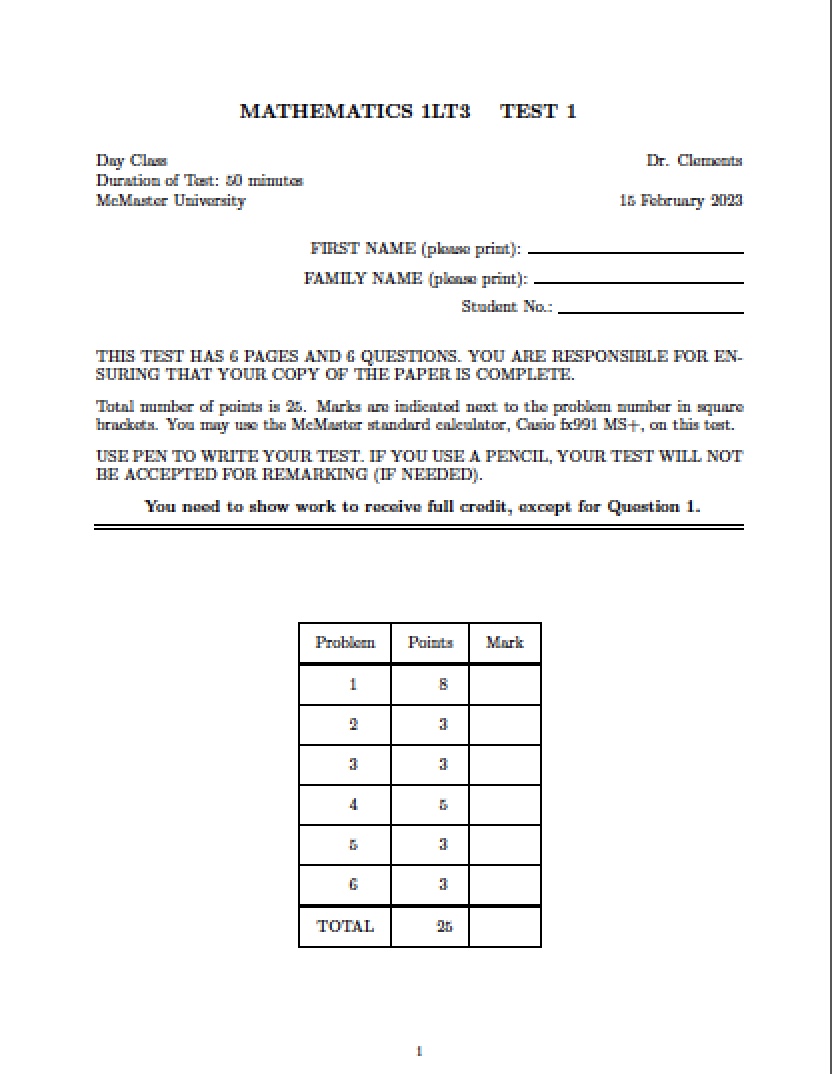
t1coverpage

(2) You may write your test in pencil or pen, but if it is written in pencil, it will not be accepted for regrading (if necessary). That being said, many students still choose to write their tests in pencil. If you write your test in pencil, when you pick it up from the TA after it has been graded, look it over very carefully in front of the TA and let them know right away if there's a discrepancy in marking. The TA must correct any errors at this time. Once you've taken your test home, you cannot bring it back at a later time and ask for a mark change.

(3) Which formulas do I need to know? General guideline: math formulas that were discussed in class, or appear in assignments, or sample tests you need to know. Formulas related to applications, will be given on a test, as needed. Take a look at the sample tests (see below under (3)) and you will notice that very little memorization is required. It is important you know how to interpret and work with the formula or a differential equation that is given in a question. For example, a question will give you a formula for the logistic growth model but you will have to identify what the constants in the model represent (for example, carrying capacity). Or, you will be given the solution to a logistic differential equation, but then you need to know how to work with it.

To Prepare:

(1) Study your lecture notes. You should be able to explain in words (both formally and in general terms) the concepts we've been studying in addition to being able to do the problems without looking at solutions. For each concept (for example, 'Stability Theorem'), cover up your notes and see if you can explain it in your own words, as if you were talking to a friend. What is the general idea of what we're doing? Why is it important? How does it fit into the bigger picture of what we're studying? What kinds of questions/applications/problems follow from this concept? Try imagining teaching someone else the concept, or presenting it to a classmate, to gain a different (higher?) perspective of the topic and to help think about the bigger picture of what you're doing.

(2) Study the exercises and activities that we did during lectures. For each exercise, cover up the solution and imagine you are looking at that question on your test. Can you describe how to do it? Ask yourself questions like "What is this question asking me to do? How do I start? Are there any special tricks or cases to remember that will help me?" Then either talk yourself through the problem if you are fairly confident you know how to do it and/or redo the problem if you find that writing helps you to learn, or review your notes if you cannot answer your own questions. Afterwards, study the solutions. When you look at solutions, pay attention to how solutions are written. It will help you figure out how much you need to write when you will be answering test questions.

(2) Study childsmath assignments 0, 1 and 2 and, if needed, go over some extra practice questions from the textbook. As mentioned above, try to cover up the answers and talk yourself through the solution. Redo any problems you feel you need to (for example, any problems which took you several tries to get correct).

(4) Practice writing sample test without using your notes: test 1 from winter 2022. Attempt to write the test without looking at your notes or reading solutions. You can find solutions on Avenue. Remember to communicate your answers well and include enough details so that the marker can follow your logic. When you are done, evaluate your own test critically using the posted solutions. Pay attention to how solutions are written. It will help you figure out how much you need to write when you will be answering test questions.

(5) Come to tutorials (suggest questions, over email or otherwise, that you wish your TA to discuss).

(6) Use the Math Help Centre for additional help, ask classmates for help (you can use our MS Teams Group Chat if you wish, or come to your instructor's(virtual) office hours).


** Detailed test information will be posted here approximately one week before the test date **


Tentative Test Dates/Times:

Test 1: February 15, 2023; 4:30pm – 5:20pm
Test 2: March 22, 2023; 4:30pm – 5:20pm

* At this time, tests have been scheduled to take place in person. In the event that course activities are moved to a virtual setting, tests will be supervised on MS Teams by the instructor and/or teaching assistants, and you be required to turn on your camera for the duration of the tests.